Crushed to Death Under a Train 斃於車下
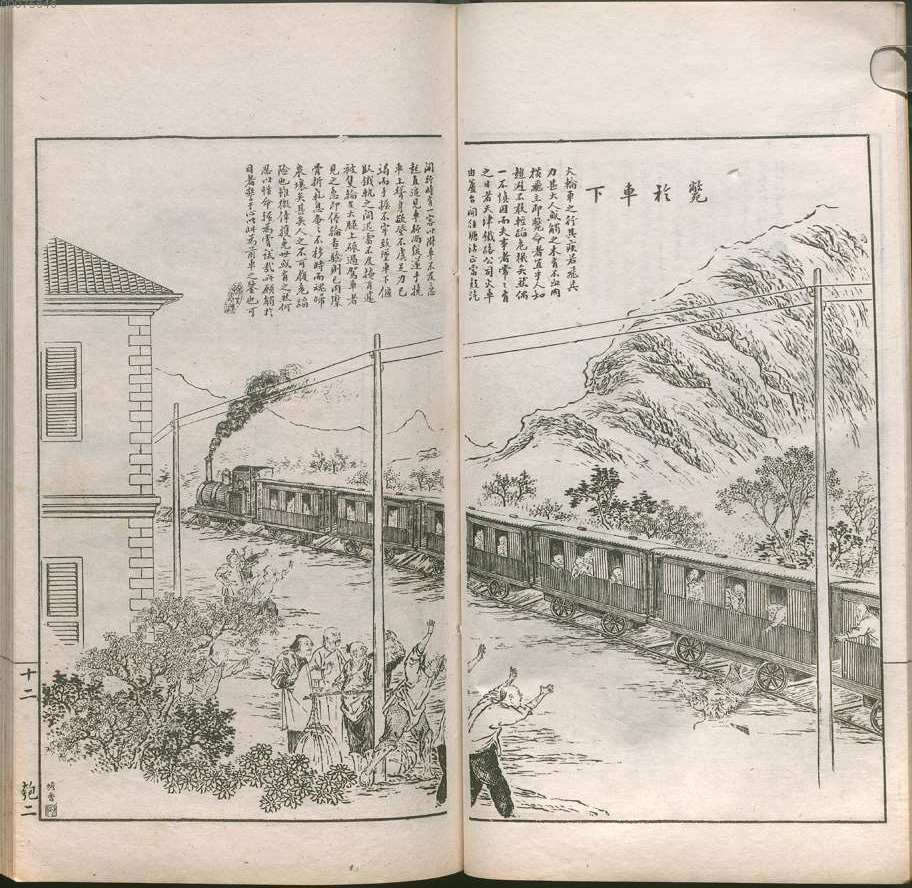
1 2019-11-18T15:49:57-05:00 Kate McDonald 306bb1134bc892ab2ada669bed7aecb100ef7d5f 35 18 Passenger Falls Beneath Train plain 2021-07-26T19:20:32-04:00 Tianjin 39.1422, 117.1767 10/16/1892 "Bi yu che xia 斃於車下." Dianshizhai huabao 點石齋畫報 (Zunwenge, comp. 尊聞閣主署).Dianshizhai: 1884-1898, Pao 2, 12. 點石齋畫報通檢: 2735 Tongjian#: 2735 Public domain. Nathaniel Isaacson NI-0004 Printed Media Kate McDonald 306bb1134bc892ab2ada669bed7aecb100ef7d5fThis page has annotations:
- 1 2021-02-03T12:30:59-05:00 Nathaniel Isaacson 9a313a8f88ba8c43c463465ac9070fc9a3b50539 Spectators on the ground and aboard the train gesticulate and point, helping guide the viewer's gaze to the accident victim, reminding us that this of the spectacular nature of the image. Nathaniel Isaacson 2 plain 2021-02-03T12:35:20-05:00 Nathaniel Isaacson 9a313a8f88ba8c43c463465ac9070fc9a3b50539
- 1 2021-02-03T12:31:52-05:00 Nathaniel Isaacson 9a313a8f88ba8c43c463465ac9070fc9a3b50539 On the verge of disappearing behind the building that occupies in the foreground, the locomotive's motion is suggested by the plume of coal smoke. Nathaniel Isaacson 2 plain 2021-02-03T12:35:21-05:00 Nathaniel Isaacson 9a313a8f88ba8c43c463465ac9070fc9a3b50539
- 1 2021-02-03T12:26:41-05:00 Nathaniel Isaacson 9a313a8f88ba8c43c463465ac9070fc9a3b50539 Annotation Nathaniel Isaacson 1 plain 2021-02-03T12:26:41-05:00 Nathaniel Isaacson 9a313a8f88ba8c43c463465ac9070fc9a3b50539
- 1 2021-02-03T12:27:41-05:00 Nathaniel Isaacson 9a313a8f88ba8c43c463465ac9070fc9a3b50539 Telegraph lines and poles perform a similar function to the train tracks, creating an orderly, rectilinear sense of perspective. Nathaniel Isaacson 1 plain 2021-02-03T12:27:41-05:00 Nathaniel Isaacson 9a313a8f88ba8c43c463465ac9070fc9a3b50539
- 1 2021-02-03T12:29:40-05:00 Nathaniel Isaacson 9a313a8f88ba8c43c463465ac9070fc9a3b50539 The mountain, rendered in more "traditional" landscape style, sets up a second vanishing point and contrasts with the train, tracks, and telegraph lines. Nathaniel Isaacson 1 plain 2021-02-03T12:29:40-05:00 Nathaniel Isaacson 9a313a8f88ba8c43c463465ac9070fc9a3b50539
This page is referenced by:
-
1
2019-11-18T15:49:56-05:00
The Wusong Railway in Western Media
43
Anglophone Descriptions of the Wusong Railway
plain
2021-09-29T16:11:35-04:00
31.2222,121.4581
51.5142, -0.0931
London
Shanghai
09/02/1876
Nathaniel Isaacson
Wusong Railway
Tianjin Railway
Illustrated London News
Dianshizhai huabao
What was newsworthy in China was newsworthy in the Anglophone world as well, and these news items shared a number of similarities in their visual repertoire. They drew upon globally circulating, mass produced images of railroads, and upon an unconscious aesthetics of the colonial gaze. Reports on the construction of the Wusong Railway also appeared in Western media, like the Illustrated London News:
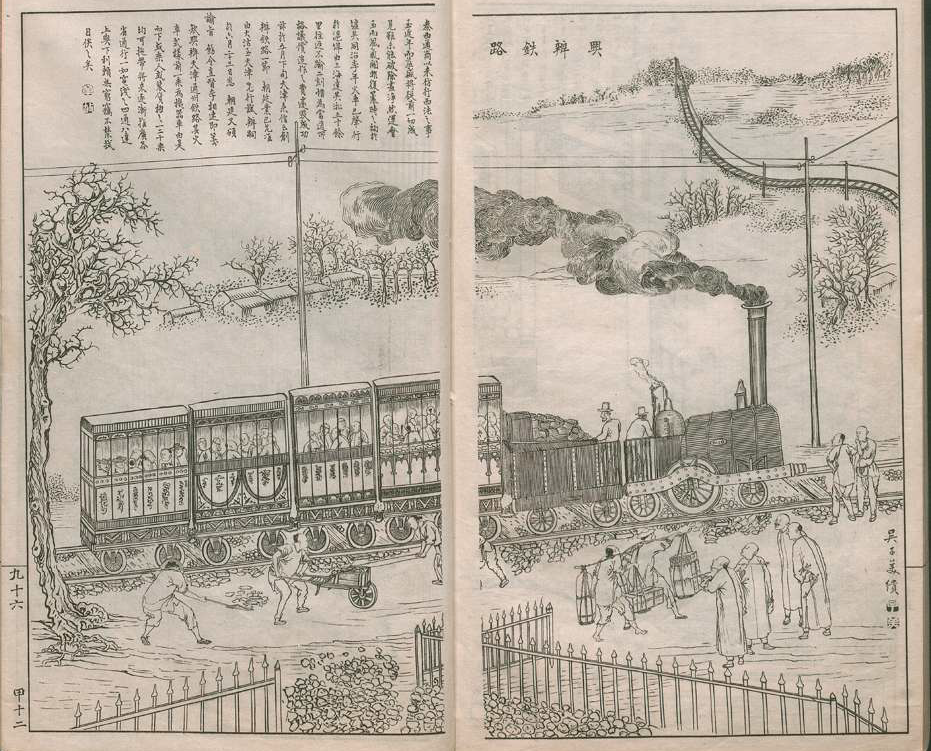
Note the similarities between this image and images of the Wusong and Tianjin Railways or a man crushed to death by the Tianjin Railway in their early stages. The western artist has chosen a similar representational mode: Chinese and foreign individuals are visually distinct in both their spatial positioning and in their attire. As opposed to the images in Dianshizhai huabao, the Illustrated London News piece also establishes a class difference by depicting those in the foremost passenger car as westerners as well. The crowd gathered to see the train helps guide the eye to the focal point of the image: the locomotive and its conductors, while establishing the event itself as a public spectacle. The westerners in the scene appear disinterested in the train, especially the man standing immediately to the right of the locomotive, who appears to have his gaze trained on the point that would be occupied by the artist. They are generally above the headline of the Chinese onlookers, some of whom are seated, both giving a clear view of their western counterparts and associating their lower plane with a closeness to the earth.
The drawing is likewise strikingly similar to this photograph, which is laid out in almost exactly the same way, other than the fact that the train occupies a more dominant position in the drawing. From left to right, we see in both images a train shed, train and western passengers and workers, Chinese onlookers, a shallow ditch, and a Chinese-style building. Whereas the plume of smoke coming from the locomotive in the drawing produces a sense of ambling motion, some individuals and elements of the photograph are blurred as a result of having moved during the exposure. Whereas the Chinese onlookers are fixated on the train in the drawing, the majority of those present in the photograph are facing the camera in observance of the commemorative moment.
The accompanying text notes that the construction and opening of the railway would be “the commencement of a new era in the history of Chinese civilization.”
-
1
2019-11-18T15:49:58-05:00
Trains as Threat
25
Discussion of Opposition to Trains and Railways
plain
2021-09-29T16:59:25-04:00
1895
Fyfe, Paul. "Illustrating the Accident: Railways and the Catastrophic Picturesque in "The Illustrated London News"." Victorian Periodicals Review 46, no. 1 (2013): 61-91.
Nathaniel Isaacson
Dianshizhai huabao
Harper's Weekly
The pages Dianshizhai huabao regularly featured reproductions of spectacular space. Readers were invited to gaze vicariously upon all number of spectacles not only by being presented with key figures, environments, and vehicles, that constituted the events, but also through the construction of the event as spectacle. This new, highly public means of seeing the world regularly focused on spectacles, and their public nature. Trains are constructed as spectacle in Dianshizhai in the same way that other events are—through the depiction of a crowd who have gathered to witness the spectacular event, whose gaze is trained on the focal point of the image. Just outside of the focal frame of the wondrous, and often fantastic events depicted in the pictorial, were the crowds of people gathered to take in the sight.
These images bear a striking resemblance to the images of railway accidents appearing in the pages of Harper's Weekly in the mid-19th century. Paul Fyfe categorizes these images as examples of the industrial and catastrophic picturesque, arguing that “the industrial picturesque used aesthetic harmony to redress the social and political disruptions of its depicted subjects” (Fyfe 65). While railroad companies used idealized images of the train and railway to create a sense of order and harmony, and to ameliorate anxieties surrounding political and technological change, Fyfe argues that accidents constituted another important aspect of the composition of the picturesque; one that focused on the aesthetics of destruction and decay and the contrast of the haphazard nature of the accident with the interrupted order of the built environment. Drawing on William Gilpin's aesthetics of demolition in the depiction of classical architecture, Fyfe argues that “the picturesque evokes a satisfying historical awe about degradation over time” (66).
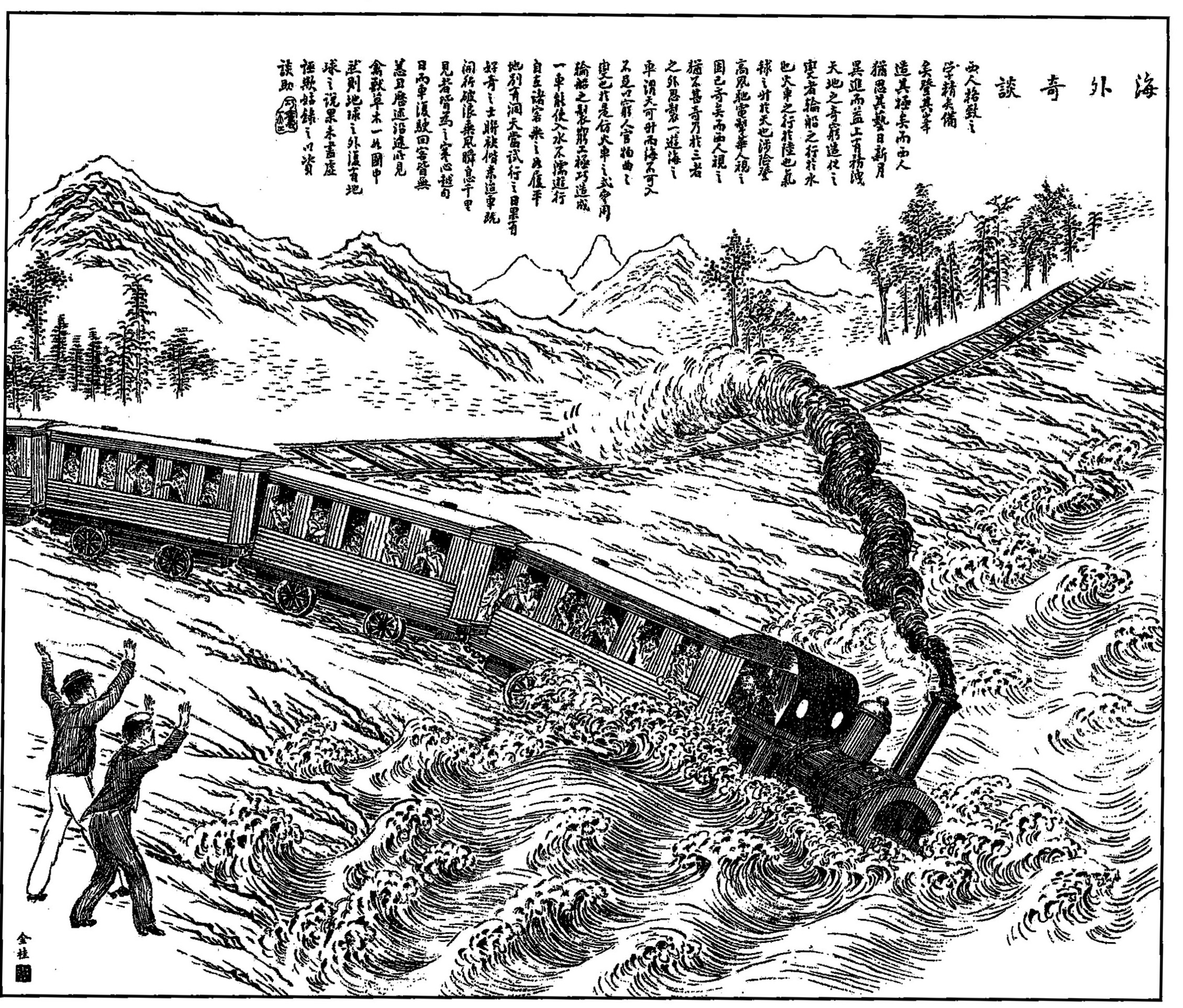
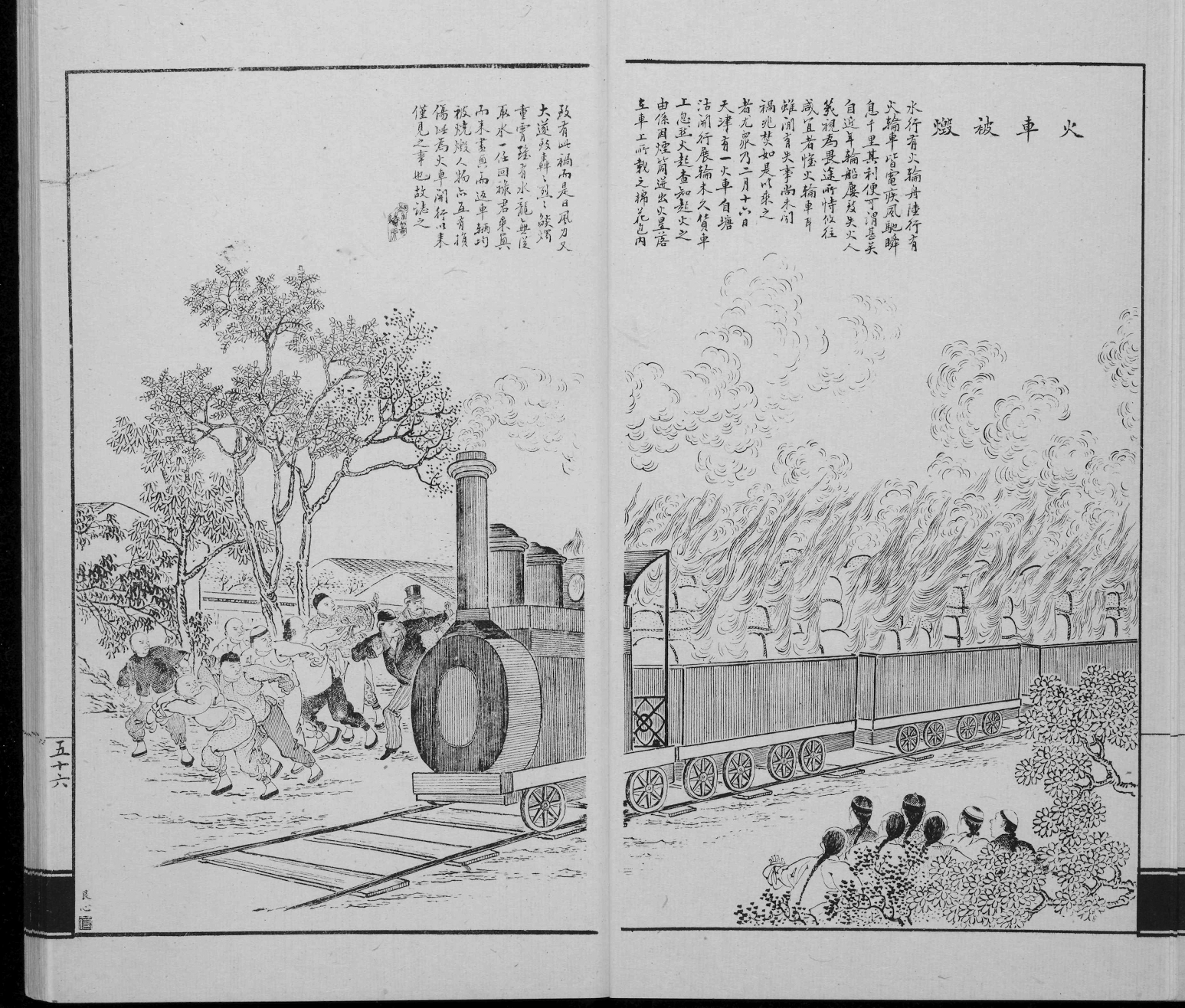
Images of accidents like that in “Train on Fire,” and “Crushed to Death Under a Train,” and the delirious juxtaposition of a train going off its rails to dive into a roiling sea with the textual description of a safe and pleasant taxonomic journey in “Train Plunges Into the Sea” are at once orderly and disorderly. The rectilinear railroads and telegraph lines bring order to the landscape by creating a perspectival point of reference, rendering three dimensional space visible in the landscape. Penetrating from foreground to background, railroad, telegraph and train produce a sense of spatial distance that they then transcend. The freight and passenger cars present a uniform order of parallel lines and mechanically-produced uniformity.
This all stands in stark contrast to the potential chaos that the railway accidents invoke. Notice how all three of the above images are split in half by the railroad. In the case of “Crushed to Death Under a Train,” the image on one side of the tracks is comprised of a fairly traditional landscape-style image of a hill, while the other side features telegraph lines and a western-style brick building. Passengers aboard the train and bystanders on the ground gesticulate broadly at the unfortunate latecomer who is crushed beneath the wheels of the train as it leaves the station. The fire consuming the cargo and the plumes of smoke rising above it in the image of a train on fire contrasts with the order of the freight train while a group of onlookers both western and Chinese shy away from the flames. Arms raised to ward off the heat as they lunge back from the flames, they appear frozen in a Peking opera liangxiang pose.
Reflecting late Qing attitudes toward the Western world in general was a tension between admiration and opprobrium. In images like that of a train catching fire, or the man crushed to death under a train, warnings about the dangers of a new technology are practical, not spiritual or superstitious. In Railroads and the Transformation of China, Elisabeth Koll describes concerns about Feng Shui as the result of stereotypes, arguing that Chinese objections to the presence of railroads were 1) very pragmatic, and 2) no more superstitious or pseudo-scientific than contemporaneous concerns about trains in European culture. Opposition to railroads and broader concern about foreign imperialism became more pronounced after the Sino-Japanese war of 1895, near the end of Dianshizhai huabao's print run. Nevertheless, in the images above, and in images that that of the train “plunging into the sea,” there is often an ironic tension between a visual description of a disaster, and a more measured textual description (or vice-versa). This tension would emerge in the contrast between the visual tone of the lithographs, and the accompanying text, or between the body of the text and the final statements offering moral judgement of events.