A Deal is Struck at Lintin, Shi Shubao becomes a Translator
1 2019-11-18T17:22:55-05:00 Kate McDonald 306bb1134bc892ab2ada669bed7aecb100ef7d5f 35 36 The Shi Family convinces Big and Little Li to bring their ships north to sell opium in Fujian. plain 2021-09-30T10:45:53-04:00 22.4167, 113.8000 Lintin 22.17730, 113.54689 Macao 06/1835 Peter D. Thilly Shi Hou Rees, John Rees, Thomas Kate McDonald 306bb1134bc892ab2ada669bed7aecb100ef7d5fOriginal: 道光十五年六月間施猴因挑運煙土不便,起意勾引夷船泊放閩洋販賣,與施漱寶商允。又各出資本洋銀一千六百元,同赴廣東澳門零丁外洋向夷人大李、小李議定煙土價銀每箱四百八十元,汁土四十塊。施猴等將番銀三千二百元買得煙土多箱,並囑其多帶煙土一併運往設法代為銷售。該夷人大李等即來夾板船裝載煙土,並邀通事陳阿跳、陽明同往正欲開行。王麻執聞知其事亦買得煙土,租駕紅頭裝載,令陳阿跳在船驗受,與大李等夷船一同駕至。
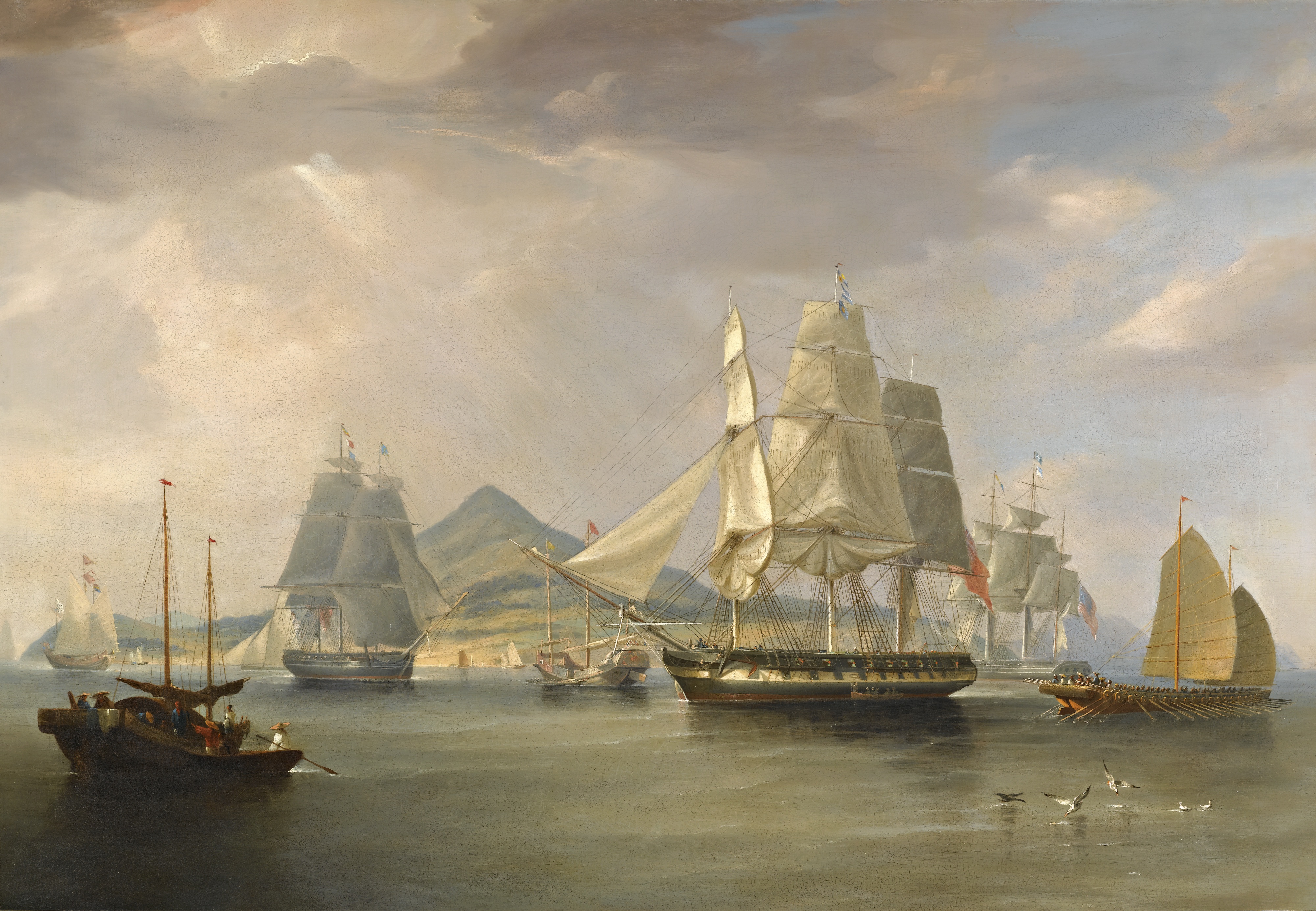
In the sixth month of the fifteenth year of Daoguang (June of 1835), Shi Hou decided that transporting the opium himself was too inconvenient, and contrived the idea of enticing the foreign boats to come anchor off the Fujian coast and sell opium. He shared the idea with Shi Shubao, and each invested 1,600 in silver taels.
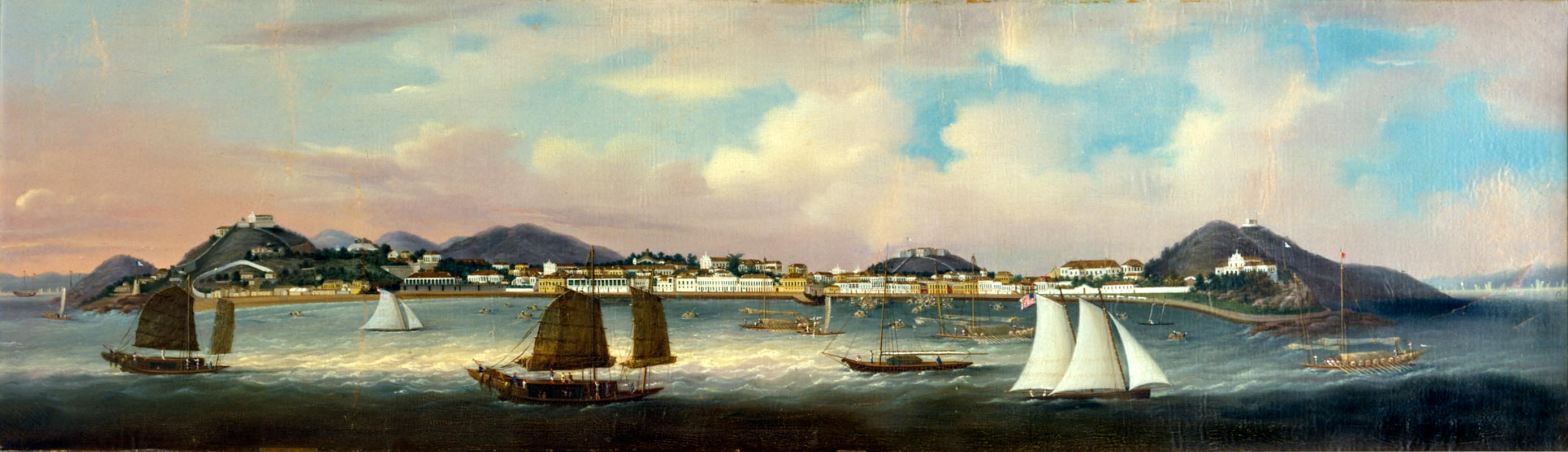
They brought the money to Lintin near Macao and gave it to the foreigners Big and Little Li, who had set a price of 480 taels of silver per chest (each containing 40 bricks of opium). Shi Hou and the others handed over their 3,200 taels, and began trying to figure out how to transport and sell the opium.
Big and Little Li had just then purchased a lorcha, and they invited on two other Chinese middlemen (Chen A-Tiao and Yang Ming) who were just then thinking of starting a business. When Wang Mazhi heard about this, he too bought a large amount of opium and hired Chen A-Tiao to rent a “Redhead Boat” [a boat from Chaozhou, in Guangdong Province] and travel along with the others up the coast.
Original: 施漱寶因時與夷船交易漸曉夷語,與澳門生辰之紅毛夷人大李、小李熟知。
Shi Shubao, due to prolonged interaction with foreigners, gradually learned to speak and comprehend the foreign language. He became intimately acquainted with the Macao-born red-hair foreigners Big and Little Li.
Source: Junji chu Hanwen lufu zouzhe (Grand Council Chinese-Language Palace Memorial Copies, often cited as LFZZ), Beijing: First Historical Archives, 03–4007–048, DG 18.10.29.
This page has paths:
- 1 2019-11-18T17:22:58-05:00 Kate McDonald 306bb1134bc892ab2ada669bed7aecb100ef7d5f The Case Against Shi Hou: A Qing Document Kandra Polatis 28 Landing page for the path that takes readers through the Qing memorial describing the Shi lineage smuggling ring. splash 5244 2020-08-14T19:18:23-04:00 1838-12-15 Peter D. Thilly Kandra Polatis 4decfc04157f6073c75cc53dcab9d25e87c02133
This page has tags:
- 1 2020-04-30T18:05:39-04:00 Kate McDonald 306bb1134bc892ab2ada669bed7aecb100ef7d5f Capital / goods David Ambaras 3 Subtag plain 2021-06-23T13:00:31-04:00 David Ambaras 1337d6b66b25164b57abc529e56445d238145277
- 1 2020-04-30T18:07:17-04:00 Kate McDonald 306bb1134bc892ab2ada669bed7aecb100ef7d5f Transport Devices Kate McDonald 2 Subtag plain 2020-09-11T17:42:50-04:00 Kate McDonald 306bb1134bc892ab2ada669bed7aecb100ef7d5f
- 1 2021-02-03T09:29:53-05:00 Kate McDonald 306bb1134bc892ab2ada669bed7aecb100ef7d5f Sourcebook David Ambaras 2 Tag for primary sources plain 2021-06-02T17:14:22-04:00 Kate McDonald David Ambaras 1337d6b66b25164b57abc529e56445d238145277
- 1 2020-08-31T19:00:40-04:00 Kate McDonald 306bb1134bc892ab2ada669bed7aecb100ef7d5f Mediator Kate McDonald 1 Subtag plain 2020-08-31T19:00:40-04:00 Kate McDonald 306bb1134bc892ab2ada669bed7aecb100ef7d5f
This page is referenced by:
-
1
2019-12-05T14:49:31-05:00
Archival Discoveries (1)
59
Quantifying and Mapping the Opium Trade
plain
2021-09-30T10:37:27-04:00
24.6500, 118.6667
Shenhu Bay
24.48535, 118.08850
Xiamen
24.86830, 118.67729
Quanzhou
24.66782, 118.64392
Yakou
1835-1840
Peter D. Thilly
Yakou Shi
This page and the next page summarize what I learned about the opium trade in 1830s Fujian when I first read the materials from the Chinese and British archives.
Quantifying the Opium Trade
Part of figuring out the opium business involves quantifying the trade. How much opium did these people sell? One conclusion I quickly reached from reading the British and Chinese sources together is that the scope of the opium trade described by the Fujian Governor in The Case Against Shi Hou is severely underplayed. In contrast to the Qing memorial, which claims that foreign opium traders “Big and Little Li” sold just twenty-seven chests of opium total in their stay in Shenhu Bay, we have evidence from the Jardine-Matheson archive that “Big and Little Li,” also known as Thomas and John Rees, could sell twenty-seven chests of opium in Shenhu Bay on a slow afternoon. One clear example of this is a report from Captain Jauncey of the Jardine-Matheson barque Austen about selling 320 chests of Malwa opium at $610/chest in just one day while stationed in Shenhu Bay during August of 1835, several months before Shi Hou supposedly lured Big and Little Li up from Macao.*
I subsequently compiled the Jardine-Matheson reports about their sales along with reports on the opium sales of their chief competitor Dent & Company, and found that these two firms sold between 1,400–2,000 chests of opium per month in Fujian for $840,000–$1,600,000. All told, the total imports into Fujian by these two firms during the years 1835–1838 ranged between 16,800–24,000 chests per year for an annual sum of $10,080,000–19,200,000. More than half of the opium that was shipped from India to China during the years prior to the Opium War was bought and sold through the Fujian receiving ship network.
Mapping the Coastal Opium Network
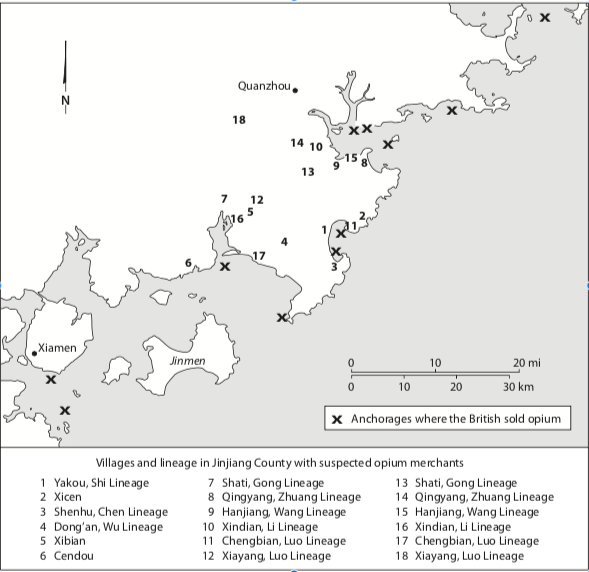
Reading the Qing memorial and the British sources together also helped me to understand the network of people that operated the opium trade in coastal Fujian. Qing sources indicate clearly that the Yakou Shi were ultimately just one of many coastal lineages involved in the trade, and Jardine-Matheson materials show that Shenhu Bay was but one of several important anchorages for the British opium traders. Dozens of coastal lineages along the Zhangzhou-Quanzhou coastline in southern Fujian during the 1830s were able to marshal the boats, people, and money necessary to make it big in the opium trade. Indeed, the region became China’s second most important opium market during the 1830s.
The above map is based on a 1840 investigation by two high officials sent down to Fujian from Beijing to investigate opium crimes, and it indicates the location of large lineages (including the Yakou Shi) who were known to collude with foreigners in the smuggling of opium in Jinjiang County. Each X on the map indicates a location that Jardine-Matheson commonly anchored their receiving ships. This small slice is indicative of a much larger reality: the map does not include the anchorages of Jardine's competition, and on shore the other counties (such as Tongan, Huian, etc.) each had their own cadre of lineages, ship-owners, and smugglers.**
*JM B2.7, Reel 496, No. 56, 12 August 1835.
**Peter Thilly, “Opium and the Origins of Treason: The View from Fujian,” Late Imperial China 38, No. 1, 2017, (155-197) 175-176.
-
1
2019-11-18T17:22:57-05:00
What really happened to Shi Hou?
46
Questions about the final result of the Qing memorial on Shi Hou
plain
2021-09-30T10:52:03-04:00
24.66782, 118.64392
Yakou
24.6500, 118.6667
Shenhu Bay
24.86830, 118.67729
Quanzhou
02/24/1839
Peter D. Thilly
Shi Hou
The memorial states that Shi Hou was sentenced to immediate strangulation for his crimes, but it also notes at one point that Shi Hou “died of illness” while in custody and awaiting sentencing, along with fourteen other unlucky prisoners. His sentence was posthumous.
Did the “real” Shi Hou die in jail?
Can we take the document at its word that the person the Qing officials arrested was indeed Shi Hou? Do we actually know that the person who was arrested under the name Shi Hou was the ringleader of the opium network? Was a person named Shi Hou really in charge of the Shi lineage smuggling operations at Yakou?
These questions are worth asking. I believe that there was an actual person who at some point went by the name Shi Hou. Here are two plausible stories about him:
- Shi Hou was a minor figure in the opium ring.The Yakou Shi lineage was large enough that it contained internal class differences, between wealthy elites and the laboring poor. Perhaps Shi Hou was employed by someone from the top of the lineage hierarchy, and the Qing state's decision to charge him as ringleader was a compromise, a clear and symbolic punishment of the lineage as a whole, sacrificing an expendable member of the lower stratum of the lineage.
If this were the case, the suspect’s decision to confess makes sense. By claiming that he had been the head criminal, and it had been his idea to bring Big and Little Li to Fujian, he acknowledged his grim fate and studiously implicated nobody else in the lineage. Such loyalty was the kind of thing that might ensure financial compensation for his family. - Shi Hou was the name of an important figure in the opium trade. Perhaps he was actually an instrumental figure in helping Jardine-Matheson establish themselves in Shenhu Bay. It is true that his name appears across a number of years and sources in Qing archives. Different people within the coastal administration knew this person’s name.
If Shi Hou had been a high-level figure in the trade, with the requisite connections and finances, it would be reasonable to suspect that the prisoner “Shi Hou” who died in jail was a stand-in, a lower strata lineage member whose family would have been paid for his service as a substitute prisoner. This practice was not uncommon in late Qing Fujian.
Is Shi Hou in the Jardine-Matheson Archive?
I have found reference to the names of just four people in the Jardine-Matheson archive that can be reliably connected to the Shi lineage.
The first three names come from a letter in Chinese that the brokers at Yakou Village sent to Captain Rees, who they refer to as “Captain Li” (李船主). The letter is signed by three people, offering only given names and no surname: Yayang (亞樣), Yabo (亞伯) and Yazhen (亞朕). The second one, Yabo, is almost certainly the “Mr. Yabe” that appears throughout the Jardine-Matheson materials as a middleman between the ship and local brokerage firms. I was unable to find any of these three names (or indeed any of the names in the memorial) in unpublished Shi lineage genealogies.
The other reference is more intriguing: a man named Shik Po who spent a lot of time aboard the Jardine-Matheson receiving ships. One representative example of Shik Po's appearance in the sources is when Captain Forbes, visiting Shenhu bay in 1839 (two years after the arrest of Shi Hou), remarked that “Shik Po the Yakow man who took refuge with us last year has again come off and is now living on board.”* Could this not be the “real” Shi Hou? Based on local pronunciation it seems more plausible that Shik Po could have been Shi Shubao, the kinsman of Shi Hou who had learned English and was never captured.
The realms of possibility
The value in this kind of speculation is thinking through the webs of different structures that a man like Shi Hou would have been enmeshed with. The lineage structure of coastal Fujianese society would have been the most dominant structure in his life. But his illegal activity also placed him in the grasp of the political-military structures of the Qing state in his region. Qing officials like the Jinjiang magistrate and the Quanzhou prefect were outsiders—people who grew up in other provinces and were appointed to Fujian from Beijing. Meanwhile, the Fujian navy was a far more local institution, as the Manchu rulers from the northeast Asian hinterland were forced to rely on locals who knew how to sail and navigate the difficult Fujian coast.
New structures with new spatialities had also advanced into the world of Shi Hou. The rising tide of British imperialism undergirded an institution like Jardine-Matheson and enabled people like William Jardine and James Matheson to source their opium and hire labor for their ships and factories. By entering into a relationship with the Rees brothers, Shi Hou and his lineage members were thus also drawn into the rapidly transforming structures of the British empire. But Rees and his employers in Guangzhou did not see themselves as empire-builders: these men were engaged in the single-minded pursuit of profit. They were pioneers in one of the formative moments and contexts for the rise of global capitalism. This too structured the possibilities for a man like Shi Hou.
*JM B2.7, Reel 495, No. 247, Forbes to Jardine, 24 February 1839
- Shi Hou was a minor figure in the opium ring.The Yakou Shi lineage was large enough that it contained internal class differences, between wealthy elites and the laboring poor. Perhaps Shi Hou was employed by someone from the top of the lineage hierarchy, and the Qing state's decision to charge him as ringleader was a compromise, a clear and symbolic punishment of the lineage as a whole, sacrificing an expendable member of the lower stratum of the lineage.
-
1
2019-11-18T17:22:55-05:00
The Crackdown
24
The raid on Yakou and arrest of Shi Hou and his compatriots
plain
2021-09-30T10:49:02-04:00
24.66782, 118.64392
Yakou
12/1836
Peter D. Thilly
Shi Hou
Original: 閩海外洋間多夷船漂泊,恐與沿海奸民勾結販運鴉片煙土違禁等陋。當經密檄責成水陸文武,各省設法查拿。當於道光十六年十一月擬。
The ocean off the Fujian coast now consistently has a multitude of foreign boats floating back and forth. We [the Governor-General and Governor] are fearful that the treacherous people of the coastal areas will collude with the foreigners to sell opium, defy the prohibition and induce other evils.
Thereupon was issued a secret call to arms among the military and civil officials on land and water, for the various provinces to strive towards finding and arresting the criminals. This was enacted in the eleventh month of the sixteenth year of the Daoguang Emperor's reign [December, 1836].
Original: 前範興泉永道戴嘉鼓、前罷泉州府深汝瀚、罷晉江縣知縣朱程等訪問。泉州府屬之於晉江縣轄衙口鄉地方有民人施猴等,私出海洋販運煙土之事。當即會恭拿獲販煙施猴等,各名錄供親驗。臣等擬辦提省審辦嚴拿物運究現。又擬該管文武續獲施塞光等四十名,起獲船隻、銀蕃、器械、煙土等件。並將施猴等在沿海荒坪搭蓋囤煙草寮全行拆毀。據經臣等批令一並解省審究,並將獲犯原由附片具奏。
The Xinghua-Quan-Yong Daotai Dai Jiagu together with the Quanzhou Prefect Shen Ruhan and the Jinjiang County Magistrate Zhu Cheng have now memorialized about Yakou Village in Jinjiang county, part of Quanzhou prefecture, where Shi Hou and others committed unauthorized maritime trade in opium.
Now we can report that the opium monger Shi Hou and others have been captured, their names and testimony recorded and personally inspected. We have ordered them to be brought to the provincial capital for prosecution, and the material evidence has been meticulously collected and examined.
The civil and military officials then proceeded to capture Shi Saiguang and 40 others. They confiscated boats, silver, weapons, opium and other items. Meanwhile, officials demolished the grass shack Shi Hou had built in the wastelands for opium storage. We then ordered all suspects to be brought to the provincial capital, and have included their testimonies in an attached memorial.
Original: 施猴先後向夷船買販鴉片、開設煙館,並接濟夷船水米無庸藐法可惡。查勾夷販煙例,無做何治罪將修其開設煙館案例定罪止絞候,現應比例從重問擬。施猴應比照奸徒將米偷運外洋接濟奸匪絞立決例,擬絞立決
Shi Hou, for purchasing opium from foreign ships and aiding and abetting those foreign ships with water and rice, is guilty of the most evil, bold lawlessness. For this reason we have followed the more severe path of punishment.
Shi Hou will be punished in accordance with the law against treacherous people bringing rice to the outer ocean to aid and abet traitorous criminals, and is sentenced to immediate death by strangulation.
Original: 施塞光自出本向夷船販買煙土開設煙館誘令良民買食,應照例問擬。施塞光即監生施肇應罷去監生
Shi Saiguang, for using silver to purchase opium from foreign boats, and for opening an opium den to entice good people to purchase and ingest opium, will be punished according to statute.
Shi Saiguang, otherwise known as licentiate student Shi Zhao, will be cashiered of his licentiate status.
Note: The memorial refers to the aspiring foreign expert Shi Shubao as “at large” (在逃). He was never captured or punished.
Source: Junji chu Hanwen lufu zouzhe (Grand Council Chinese-Language Palace Memorial Copies, often cited as LFZZ), Beijing: First Historical Archives, 03–4007–048, DG 18.10.29.
-
1
2019-11-18T17:23:00-05:00
The Rees Brothers: Big and Little Li
22
John and Thomas Rees, aka Big and Little Li, competing opium merchants
plain
2021-09-30T11:00:31-04:00
24.6500, 118.6667
Shenhu Bay
01/21/1836
05/17/1836
Peter D. Thilly
Rees, John
Rees, Thomas
“We transshipped to the Col Young some opium and then proceeded to Chinchew bay to sell. Had been there about a week when Rees came up and requested me to go to Chimmo bay as he found it unpleasant to be near to his brother who he was very sorry to inform me was not a man of his word, that he had arranged prices with him and then undersold him.”
Captain Mackay to William Jardine, January 21st, 1836.*The two men referred to in the Case against Shi Hou as “Macao-born foreigners Big and Little Li” were John and Thomas Rees, estranged brothers who were captains in the opium fleets of the rival firms Jardine-Matheson (John) and Dent & Co. (Thomas). Thomas, the elder brother, had been the captain of the “Lord Amherst” voyage of 1832, a trip organized by a coalition of British opium merchants to scout and map the Chinese coast for the purposes of commercial expansion.
During the mid-1830s, the two brothers were frequently stationed at the Shenhu Bay anchorage at the same time, competing with each other for the business of the brokers on shore. In the above quote, Jardine-Matheson's Captain Mackay discusses the tense relationship between the two Rees brothers, who were constantly feuding with one another over opium pricing in Shenhu Bay.
In the summer of 1836, the Rees brothers had become fed up with each other. There had been a constant string of lies and broken promises between the two men, and they decided to draw up a written contract to equalize sales and prices in Shenhu Bay. As noted in the text of the contract, the agreement accounts for “Manderrine fees of $10 per chest. (sic)”
John Rees erected Lexden Terrace in Tenby, Wales, upon his return from China. It remains today as a visible legacy of the Rees brothers' opium fortunes.
*Source: JM:B2 7 [R. 495, No. 76] MacKay to Jardine, 1.21.1836
-
1
2020-07-22T12:21:35-04:00
Brokers and Middlemen
15
Jardine-Matheson sources on local Chinese brokers and middlemen
plain
2021-10-01T17:28:29-04:00
1834-1838
Peter D. Thilly
To ensure success brokers must be employed—I was quite helpless without them and before again sailing for that or any new market I must procure from Macao at least a couple. JM B2 7, Reel 495, 50, May 27, 1835.
In the Jardine-Matheson archive, “brokers” are the Chinese people who either facilitate opium transactions or themselves purchase the drug. In the above quote, Captain MacKay notes that brokers for trips to southern Fujianese ports like Shenhu Bay can be found in Macao. Not many of these brokers are named in the archive, but one does appear with some detail and frequency: a certain “Mr. Yabe.”
In 1834, Yabe first appears as a contact of the enigmatic Prussian missionary, Charles Gützlaff, who was then working for Jardine-Matheson as a translator. In the second quote, Yabe essentially recommends the receiving ship system, much as Shi Hou was alleged to have done a few years later.
Your correspondent Yabe of the firm Sam Toan Moh (三全茂), sighs under the wrath of the Mandarins and does not dare to come on board, he has however fulfilled a part of the contract, and I doubt not will trade more largely. JM B2 7, Reel 495, 10, February 2, 1834.
Yabe repeatedly requested Mr. G to tell me that he wished to have a ship up every month as he prefer purchasing from foreign ships than run the risks with their own boats, he also said that he has made arrangements with the Mandareens for the next arrival, they will not be troublesome unless some fresh hand come on at the station. JM K1-2, Extracts from Company Records, 10, September 8, 1834.
A few years later, in the months following the arrest of Shi Hou and his compatriots, Yabe is living in fear.
Capt. Dodd observed on the 5th Instant the Mandareen junks landing their men at Mr. Yabe's village and a fire soon after took place. The reports are that Mr. Yabe, a broker who trades largely with us, left the village in time and the Mandareen burnt his house and several other people's. JM A8 123, 12, April 1837.
There has been proposals by Mr. Yabe, but he was in such a fright the other day that he told me to go away for 10 to 14 days. JM B2 7, Reel 495, 150, June 16, 1837
In some of his final appearances in the archive, Yabe has gotten into even hotter water in connection with a lineage feud and some slain government officials.
You will observe by the enclosed occurrence that our business in both bays have been much interrupted by a large fleet of Mandarins and I have been informed that their appearance here has been in consequence of Mr. Yabe's party shooting government officers when interfering in a fight with two villages. JM B2 7, Reel 495, 188, April 21, 1838.
During the last week the brokers are under a great alarm by the arrival of the Chu Kang and another officer from Foo Chow Foo. They have come to settle a query between two large towns, and also to squeeze the party that shot a Government officer last month near Mr. Yabe’s village. I believe the latter is settled on a payment of $8000, and these officers are expected in the bay in a day or two, many of the brokers have absconded, and most of the principal ones came off to me last night to remain for protection here, and the others beg me to leave for 10-12 days, but it is quite uncertain if it is the intention of their officer to interfere with the opium dealers or not. JM B2 7, Reel 495, 224, September 24, 1838.


This page references:
- 1 2019-11-18T17:22:59-05:00 Lintin 25 A description of Lintin, the primary opium depot in the Pearl River Delta. plain 2021-10-01T17:43:50-04:00 22.4167, 113.8000 Lintin 1820-1839 Peter D. Thilly Jardine, William
- 1 2019-11-18T17:23:00-05:00 The Rees Brothers: Big and Little Li 22 John and Thomas Rees, aka Big and Little Li, competing opium merchants plain 2021-09-30T11:00:31-04:00 24.6500, 118.6667 Shenhu Bay 01/21/1836 05/17/1836 Peter D. Thilly Rees, John Rees, Thomas
- 1 2019-11-18T17:22:59-05:00 Macao 21 Macao was a central location for Anglo-Chinese networking in the opium trade plain 2021-10-01T17:46:11-04:00 22.17730, 113.54689 Macao 05/27/1835 Peter D. Thilly Jardine, William