This publication is hosted on resources provided by the College of Humanities and Social Sciences IT department at NC State University.
Ōsato, “Zainichi Chūgokujin rōdōsha, gyōshōnin"
1 2018-06-29T15:35:56-04:00 David Ambaras 1337d6b66b25164b57abc529e56445d238145277 2 4 plain 2018-07-11T15:03:29-04:00 David Ambaras 1337d6b66b25164b57abc529e56445d238145277For 1918 government directive to prefectural governors re causes for prohibiting entry to foreigners: see p. 210.
See also: Yamawaki Keizō, Kindai Nihon to gaikokujin rōdōsha: 1890-nendai kōhan to 1920-nendai zenhan ni okeru Chūgokujin, Chōsenjin rōdōsha mondai (Tokyo: Akashi Shoten, 1994).
This page has tags:
- 1 2018-04-23T13:40:47-04:00 CHASS Web Resources 398fc684681798c72f46b5d25a298734565e6eb8 References CHASS Web Resources 1 References tag for all modules and essay plain 2018-04-23T13:40:47-04:00 CHASS Web Resources 398fc684681798c72f46b5d25a298734565e6eb8
This page is referenced by:
-
1
2018-04-23T13:40:24-04:00
Fuqing peddlers in Japan
32
Japanese immigration laws and Fuqing migrant networks.
plain
2018-12-05T08:31:05-05:00
25.72114, 119.38433
David R. Ambaras
In 1899, the Japanese state, fearing the influx of low-wage Chinese workers, enacted specific measures to control Chinese migration, which had first grown dramatically after the establishment of the treaty ports and foreign concessions in the mid-nineteenth century. Following the revision of the Ansei (unequal) treaties and abolition of extraterritoriality (as well as Japan’s 1895 victory over the Qing), the government issued Imperial Ordinance 352 and Home Ministry Ordinance 42, which prevented most Chinese laborers from moving beyond the former treaty ports and concessions. These orders did permit the entry of itinerant peddlers, provided that they registered with the police in their various destinations.
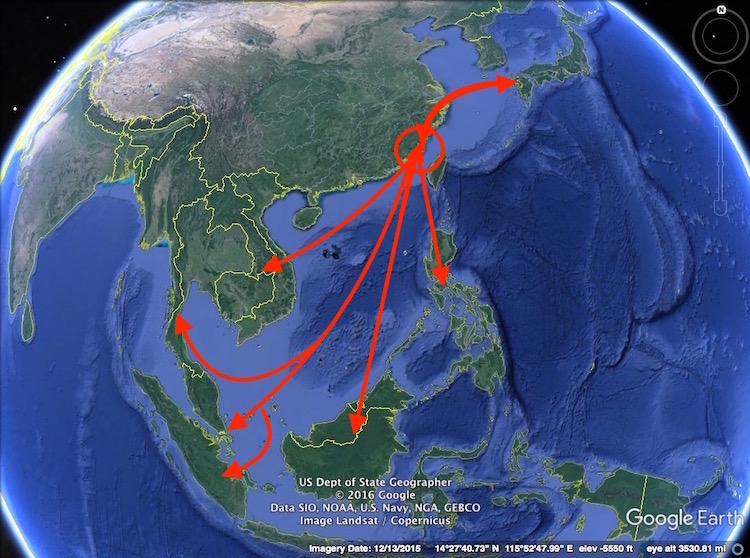
Peddlers from Fuqing constituted one of the most important groups who entered under these conditions. Their routes extended across the archipelago, and were part of a far larger network of Fuqing migration routes in the Qing and Republican eras.
According to historian Shiba Yoshinobu, the peddling of medicinal products, silk, cotton cloth, and sundry goods was in particular the specialized operation of groups centered on Fuqing's Gaoshan area and on southern Zhejiang. This Sino-Japanese trade in medicinal products, woven cloth, and sundry goods dated back to the Nagasaki era, and the extent of Japanese demand for Chinese goods led many Chinese to migrate to Japan in the Meiji era with the intention of opening up hinterland markets. The Japanese colloquially called these peddlers "furoshiki Nankin" (China bundlers), supposedly because of the bundles of cloth they carried on their routes.
See also: Descriptions of Fuqing.
-
1
2018-04-23T13:40:20-04:00
Border (in)security
16
Decisions on admission or denial of entry of Chinese migrants; depictions of Chinese criminality in 1920s.
plain
2018-12-05T08:41:02-05:00
32.74837, 129.86767
34.69373, 135.50216
35.67285, 139.8174
David R. Ambaras
Decisions at the border
Though many of these migrants settled easily into Japanese society, peddlers had also provoked concerns about their involvement in child trafficking and in the alleged procurement of human organs for making medicine.
Official suspicions of these mobile foreigners only increased in the years after World War I. Japanese authorities, worried about the illegal entry of unskilled Chinese workers, feared that immigrants might declare themselves as peddlers at their port of entry and then take up employments in contravention of Ordinance 352. In 1918, the Chinese and Japanese governments agreed to permit each other’s nationals to enter their countries without a passport or nationality papers. To prepare for this situation, in the same year, the government issued a directive authorizing prefectural governors to prohibit the entry into Japan of any foreigner who (1) lacked a passport or proof of nationality (Chinese were exempted from this provision); (2) was suspected of acting against the interests of the Japanese empire or abetting its enemies; (3) posed a threat to public order or morals; (4) engaged in vagrancy or mendicancy; (5) suffered from a contagious disease or any other ailment that posed another risk to public health; or (6) risked requiring public assistance due to mental illness, poverty, or other causes.
For example, in September 1926, the Kyoto main office of the Kyoto-Osaka-Kobe Fuzhou Businessmen’s Local Origin Association (Keihanshin Futsuō Jitsugyō Dōkyōkai) submitted a request to Nagasaki harbor police that two brothers from Fuqing/Gaoshan, 15-year-old Lin Xianghu and 18-year-old Lin Xiangfan, be admitted to Japan as clothes peddlers; the association offered to act as guarantor for the boys. Nagasaki police contacted the Osaka government for information. In response, Osaka Governor Nakagawa Nozomu wrote, in a classified message to the Home and Foreign Ministers and to the governors of several prefectures:
Recently, many of the so-called cloth peddlers who come over from the Fuzhou area have switched to working as laborers or have committed theft and other delinquent acts, so controls on their entry into Japan have become more strict. Hence, to facilitate their entry, [peddlers] appear to have taken to issuing irresponsible promises of guarantee, as a formality, in the name of some association. Before this group was formed, another Fuzhou Local Origin Association had existed; it produced many delinquent elements, and we have many examples of its failure to follow through on its guarantees.
With regard to the two brothers, Nakagawa recommended admitting the younger, who was to be employed as a clerk in the cloth merchant’s main shop in Osaka, but denying entry to the older, who was to be a peddler in the shop’s employ.
Depictions of criminality
Surveillance of those Chinese admitted to Japan was quite rigorous, with port-of-entry officials wiring migrants' stated places of destination and the latter reporting back on their arrivals, departures, and movements. (To my knowledge, no one has really worked on these documents: their contents or their modes of circulation.) Increasingly, government officials complained about the widespread presence of “gangs of delinquent Chinese,” particularly shoplifting gangs; men from Fuqing figured prominently in these reports. The press also weighed in with stories such as this one:
A Major Chinese Shoplifting gang with 800 Members -- Losses Nationwide Exceed 500,000 Yen -- The Metropolitan Police Force Takes Determined Action
(This article noted that the Japanese common-law wife of a gang member was also under investigation for her participation -- a sign of the dangers to Japanese women of involvement with Chinese men.)
The number of deportations of Chinese immigrants also increased significantly in the 1920s, provoking an outcry among the immigrant community and remonstrations from Chinese consular officials.
Popular fears of an influx of illegal unskilled laborers had also been a principal factor in the massacre of hundreds of Chinese, mostly from Wenzhou, in Tokyo working-class neighborhood of Ōshima-chō in the aftermath of the 1923 Great Kantō earthquake -- part of a pogrom that is better known for having taken the lives of some 6,000 Koreans. Chinese in Japan had to live with both these images/suspicions of criminality and the knowledge of the potential for violence against them. These factors shaped their mobilities and subjectivities in ways that demand further investigation.